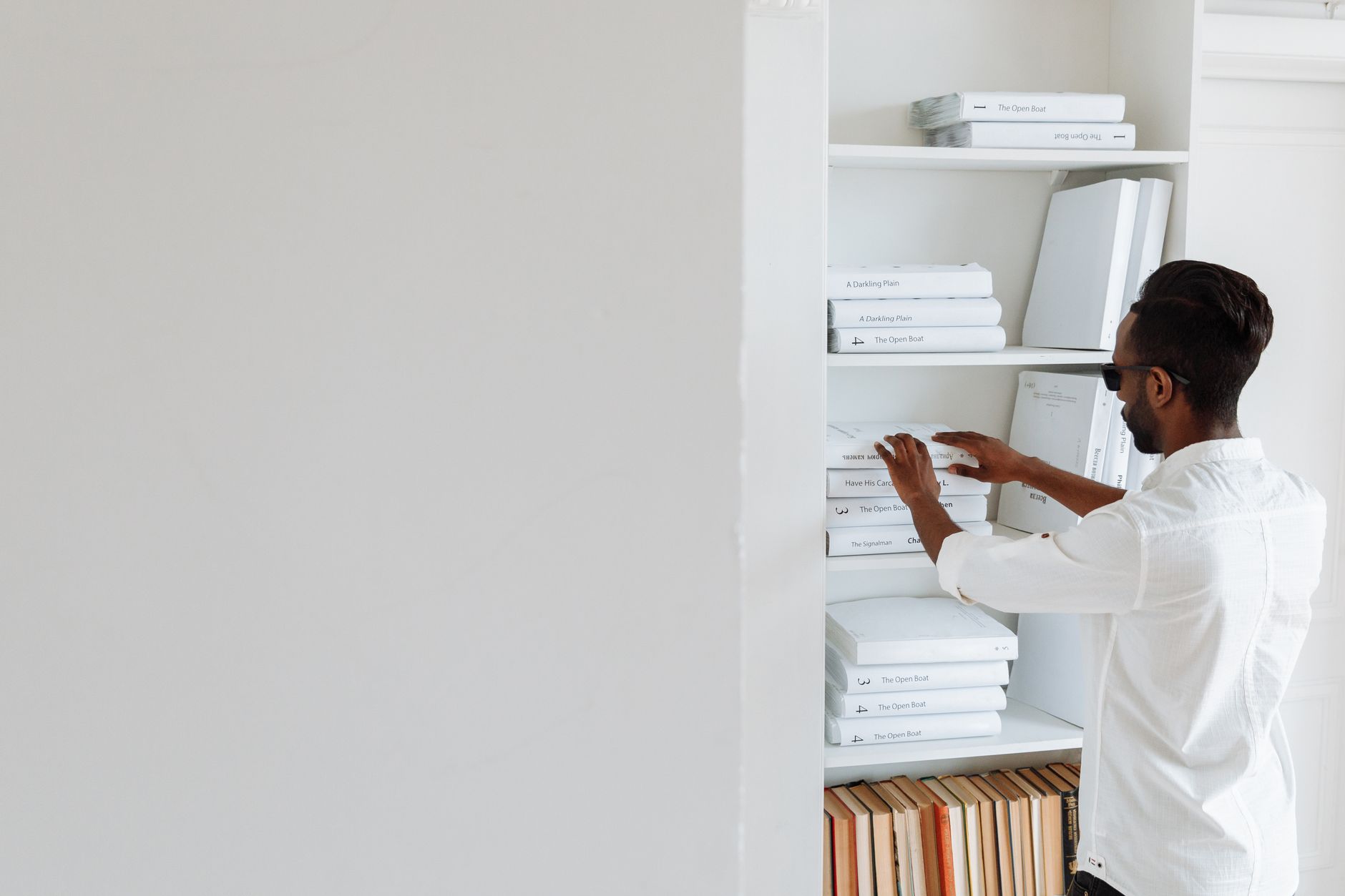
Bookshelves are often cited as an acoustic treatment in home studios and offices. The reality is more nuanced — they can help, but the effect depends heavily on what is in them and how they are arranged.
How Bookshelves Contribute Acoustically
A bookshelf filled with books of varying sizes creates an irregular surface that scatters sound in multiple directions. This is diffusion — rather than reflecting a sound wave back in a single coherent direction, the irregular surface breaks it up. Diffusion reduces harsh reflections and makes a room sound more natural without making it feel acoustically dead.
Books themselves also provide some absorption. Dense paper and binding materials absorb some sound energy, particularly at mid and high frequencies.
The Limitations
Bookshelves are not a substitute for purpose-made acoustic treatment. They provide diffusion and modest absorption, but an empty shelf or one filled with uniformly sized books offers less benefit. The acoustic effect depends on the irregular arrangement of books of different sizes, thicknesses, and depths.
Bookshelves also provide essentially no low-frequency absorption. Bass frequencies pass through furniture with minimal interaction. For rooms with bass problems — home theaters, music listening rooms — corner bass traps are necessary regardless of how many bookshelves are present.
When Bookshelves Are Genuinely Useful
In living rooms and home offices, large bookshelves against shared walls or on the back wall of a room provide diffusion that reduces acoustic harshness without making the room feel studio-like. For people who want to improve room acoustics without obvious acoustic treatment products, bookshelves are the most aesthetically natural solution.
They are particularly useful on walls opposite a primary listening or working position, where they scatter reflections that would otherwise arrive as a distinct echo from a flat surface.
How to Maximize Bookshelf Acoustic Effect
- Fill shelves with books of varying heights and depths rather than organizing by uniform size
- Leave some shelves with irregular arrangements of items — decorative objects, small boxes, varied-sized books
- Position the bookshelf on a wall where reflections would otherwise be problematic
- Choose deep shelves — 12 inches or more — to increase the acoustic irregularity of the surface
The Bottom Line
Bookshelves help. They are not a primary acoustic treatment, but a room with well-filled bookshelves sounds better than the same room without them. Use them alongside purpose-made panels for a complete treatment rather than as a standalone solution.